Heritage Impact Assessment & Planning Strategy.
For an application for a rural workers dwelling sat adjacent to a Grade I listed Church.
East Anglian Heritage was commissioned to undertake the writing of a HIA by the client and also write a supportive heritage letter due to the concerns raised by the heritage consultee for the LPA in a pre-application advise letter. With the consultee noting that the proposed site could lead to harm of the setting of the Grade I listed church.
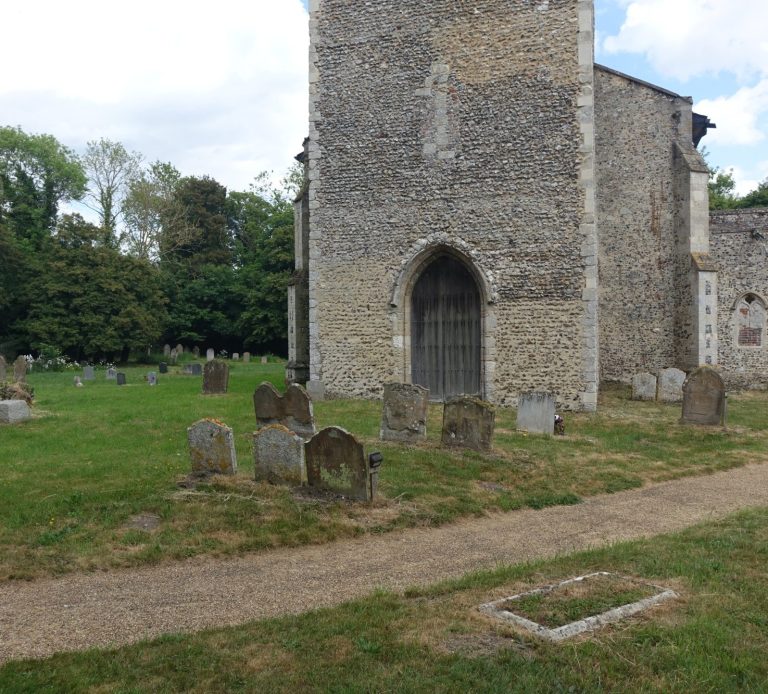
IThe Church of Saint Peter at Cringleford, Norfolk © East Anglian Heritage
Land At Dennington Road, Brundish, Suffolk
The Challenge
A proposed rural worker’s dwelling was identified by the Local Planning Authority as likely to result in harm to the setting of multiple listed buildings, including the Grade I Church of St Lawrence.
Pre-application advice established a clear position:
- Development within this parcel was assumed to affect the setting of designated heritage assets;
- Any identified harm would carry substantial policy weight;
- A refusal was therefore a realistic and foreseeable outcome.
This created a typical but critical problem:
- An assumption of harm without a tested evidential basis
The EAH Approach
East Anglian Heritage was commissioned to undertake a full Heritage Impact Assessment supported by a legal planning statement, applying the EAH House Method:
Evidence → Significance → Setting → Impact → Planning Balance
The assessment did not begin with policy conclusions it began with reconstructing the historic landscape and asset relationships from first principles.
Understanding the Historic Landscape
The site formed part of the former Brundish Hall farmstead, now:
- Redundant;
- Heavily overgrown;
- Fragmented, with only partial structural remains.
Historic mapping and documentary evidence demonstrated that:
- The site functioned as part of the agricultural working side of the hall;
- It was physically and functionally separate from the domestic and designed aspects of the estate;
- The former hall itself has been lost from the landscape.
This immediately reframed the key issue:
- The site was not part of a designed or meaningful heritage setting
- It was part of a working agricultural complex
Setting: Testing the Assumpton of Harm
The critical question was not visibility, but:
- Does the site contribute to the significance of nearby heritage assets?
Detailed site inspection and analysis established:
- The churchyard itself is enclosed and self-contained
- The site does not form part of: Key Views; Historical associations; Designed Landscape Relationships.
This resulted in:
- The site is experienced as a separate, enclosed, post-agricultural parcel
- It does not contribute to the setting of the Church or nearby listed buildings
Impact: From Assumption to Evidence
Once setting was properly defined, the impact test became clear:
- No contribution to significance
→ therefore - No impact on significance
This is a critical distinction often missed in weaker HIAs.
The conclusion was not stylistic or opinion-based, it followed directly from the evidential chain.
Planning Position
Planning Position
The accompanying planning statement addressed the misapplication of heritage policy at pre-application stage, clarifying that:
- Under Section 66(1), decision-makers must give weight to preserving setting
However:
Preserving setting includes situations where development causes no harm
Case law (including South Lakeland and Barnwell Manor) confirms:
No harm = statutory duty satisfied
This directly challenged the assumption that:
“Any development here would trigger harm and policy conflict”
Outcome
The Heritage Impact Assessment established that the site does not make a meaningful contribution to the setting of nearby listed buildings and that the proposal would not result in harm to their significance.
Through the determination process:
- Historic England raised no objection;
- The Council’s Heritage Officer identified only a very low level of less than substantial harm to the Church of St Lawrence;
- No harm was identified to Chantry Farmhouse.
This represents the lowest end of the policy spectrum, where heritage impact is negligible.
Planning permission was subsequently granted, with the identified level of impact readily outweighed by the scheme’s benefits.
View Southeastwards form the potential site toward the Church of St Lawrance Brundish Suffolk © East Anglian Heritage
East Anglian Heritage is proud to be
Member of FAME
Federation of Archaeological Managers and Employers, the archaeological trade body

Member of the Suffolk Design Collective
Suffolk Design Collective is a professional network bringing together architects, designers, planners and built-environment specialists working collaboratively to promote high quality design and placemaking across Suffolk.